Build a Video Marketing Team for Enterprise in 2026

Most marketing executives don't struggle to understand why video matters. They struggle to build video marketing team enterprise structures that actually produce measurable business outcomes rather than a backlog of polished content no one can attribute to revenue. The typical approach, hire a videographer, add a social media manager, and call it a team, creates coordination chaos and creative bottlenecks that scale poorly. This article gives you a sequenced, system-driven framework for creating video content teams that stay lean, move fast, and connect directly to pipeline.
Table of Contents
- Key Takeaways
- Building your enterprise video marketing team foundation
- Hiring sequence and team composition
- Operational systems for scale
- Common mistakes and how to prevent them
- Measuring team success and verifying outcomes
- My honest take on building enterprise video teams
- Ready to scale your video marketing output?
- FAQ
Key Takeaways
| Point | Details |
|---|---|
| Strategy precedes hiring | Define business goals and funnel mapping before you write a single job description. |
| Lean teams outperform large ones | A well-structured team of 3–7 people consistently outproduces larger groups with unclear roles. |
| Hiring sequence determines output | Build in the order of strategy, then production, then distribution to avoid coordination bottlenecks. |
| Systems replace supervision | Documented workflows, approval processes, and automated reporting reduce management overhead significantly. |
| Measure business impact, not views | Connect video metrics to pipeline contribution, CAC, and LTV to earn executive buy-in and budget. |
Building your enterprise video marketing team foundation
Before you post a single job listing, you need a strategic foundation that defines what your video program is actually supposed to accomplish. Successful enterprise video programs begin by selecting one primary business goal, whether that is awareness, lead generation, sales conversion, or customer retention, and then mapping specific video formats to funnel stages aligned with measurable KPIs. Without this step, you end up with a team producing content based on gut instinct rather than business logic.
Start by answering these four questions clearly:
- What is the single primary business outcome this team must drive? Revenue contribution, pipeline velocity, and customer acquisition cost reduction are all valid answers. "Brand awareness" alone is not sufficient at the enterprise level without a measurement plan attached.
- Who is your audience at each stage of the funnel? Use your existing CRM data, intent data platforms, and customer research to define the specific behaviors and content preferences of prospects at awareness, consideration, and decision stages.
- Which video formats map to which funnel stages? Short-form social video and thought leadership content belong at the top. Product demos, case studies, and comparison videos belong in the middle. Testimonials and ROI-focused content close deals at the bottom.
- What does your documented workflow look like? Before hiring, document the production process from brief to publish, including who approves what and when. This becomes your operating manual for every new hire.
Treating video as a measurable system, rather than a series of creative one-offs, is what separates enterprise video programs that generate ROI from those that generate impressive reels. Your strategic foundation is the document that makes this possible. It tells every team member why they are doing what they are doing, and it gives you a basis for evaluating performance that goes beyond view counts.
Pro Tip: Before finalizing your video strategy document, run it past your sales team. They will tell you which objections and questions appear most often in deals, and those answers should become your first round of video briefs.
Hiring sequence and team composition
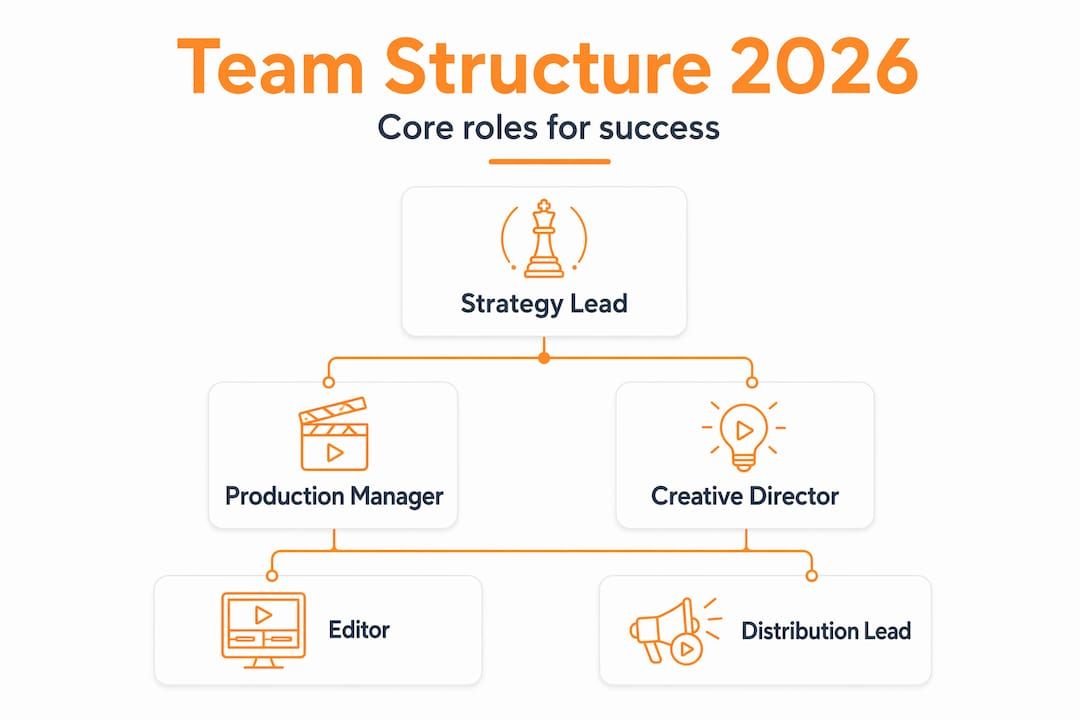
Once your foundation is documented, the order in which you hire matters more than the total number of people you add. Building lean video content teams with clear decision frameworks eliminates coordination overhead and accelerates content output far more effectively than simply adding headcount. A team of three to seven people with well-defined roles and documented systems will consistently outproduce a team of fifteen with overlapping responsibilities.
Here is the hiring sequence that works at the enterprise level:
-
Video strategy lead. This person owns the editorial calendar, the brief process, and the connection between video output and business goals. They should be comfortable reading analytics, writing strategy documents, and communicating ROI to senior stakeholders. Hire this role first. Without it, every subsequent hire will default to their own creative instincts.
-
Production coordinator or creative project manager. This role manages the logistics of getting video from brief to final cut, including scheduling shoots, managing vendors, tracking revisions, and enforcing deadlines. Splitting responsibilities between production coordination and creative project management prevents bottlenecks and maintains brand consistency across a high volume of content.
-
Video editor or post-production specialist. Depending on your production model, this may be an in-house hire or a retained external resource. At the enterprise level, budgets commonly range from $50,000 to $500,000 annually for comprehensive campaigns, and many organizations use a hybrid model with in-house editors for ongoing content and agency partners for high-impact brand productions.
-
Distribution and analytics specialist. This person owns paid and organic distribution, UTM tracking, platform optimization, and performance reporting. They are the link between your creative output and your revenue attribution data.
-
Additional specialists as volume demands. Motion graphics, scriptwriting, and platform-specific content creation (short-form vertical video, for example) can be added as dedicated roles once your core four are producing consistently.
Pro Tip: When evaluating candidates for any of these roles, ask them to walk you through a production process they built or improved. People who think in systems will describe workflows, tools, and handoff points. People who think in isolation will describe their own creative contributions. You want the former.
Operational systems for scale
A well-composed team without strong operational systems will still bottleneck. The systems you build around your team determine whether you can scale from 10 videos per quarter to 40 without a proportional increase in headcount or management time.

Your production management system should track every video asset through defined stages, from brief to scripting, filming, editing, review, and distribution, with clear task ownership at each stage. Tools like Asana, Monday.com, or Airtable work well for this when configured specifically for video production workflows rather than used as generic task lists.
Approval workflows deserve particular attention at the enterprise level. Multi-step content approval workflows prevent governance bottlenecks by enforcing role-specific review states and requiring resubmission on rejection with timestamped comments. A typical enterprise approval chain involves production, creative, brand, legal, and executive reviews. Structured approval steps with defined stakeholder roles minimize post-publication corrections and reduce the risk of compliance violations, which matters significantly in regulated industries.
| System | Purpose | Key feature to require |
|---|---|---|
| Project management platform | Track production stages and task ownership | Custom workflow stages, not generic to-do lists |
| Video CMS | Secure storage, governance, and distribution | Role-based access and GDPR compliance |
| Approval workflow tool | Multi-step review with audit trail | Timestamped comments and mandatory resubmission |
| Analytics dashboard | Connect video performance to revenue | UTM integration and CRM data sync |
| AI automation layer | Reduce manual task assignment and reporting | Trigger-based workflows tied to production milestones |
Content governance extends beyond sign-off. A video CMS with role-based access, GDPR compliance, and secure streaming enables safe content reuse and governance across departments, which is particularly relevant when multiple business units or regional teams need access to centralized video assets.
On the measurement side, enterprise video metrics must connect to lead generation and revenue through UTM parameters and CRM integration. Automated weekly reporting dashboards that track video volume, engagement rates, and performance drops linked to revenue outcomes give your team and your stakeholders a clear picture of what is working.
Common mistakes and how to prevent them
Even well-designed teams run into predictable problems. Knowing what those problems look like in advance gives you the ability to build prevention into your structure from the start.
- Approval paralysis. The most common productivity killer in enterprise video is an overly large review committee with no enforced workflow. When anyone can comment and no one has final authority, videos sit in review for weeks. Fix this by defining exactly who has approval authority at each stage and building that into your workflow tool with hard deadlines.
- Vanity metric reporting. If your team's success is measured by views and likes, you will optimize for views and likes. Connect your reporting to pipeline contribution and customer acquisition cost from day one, even if the attribution is imperfect at first.
- Role overlap and burnout. When job descriptions are vague, people either duplicate work or avoid it entirely. Write role descriptions that define specific deliverables and decision rights, not just responsibilities. This is especially important as you scale from three to seven people.
- Brand and legal misalignment. Creative teams that operate without regular touchpoints with brand and legal end up producing content that requires expensive rework. Build brand and legal review into your workflow as a standard stage, not an exception.
- Technology debt from disconnected tools. Using separate platforms for production management, asset storage, distribution, and analytics that do not communicate with each other creates manual reporting work that slows your team down. Automating video production task assignments and integrating performance data to CRM enables your team to scale without adding administrative overhead.
Pro Tip: Run a quarterly workflow audit with your team. Ask each person to identify the single biggest friction point in their process. You will consistently find one or two systemic issues that, when fixed, unlock disproportionate output gains.
Measuring team success and verifying outcomes
Building the team and the systems is the first half. Verifying that they are producing business impact is the second, and it requires a measurement framework tied to funnel stages rather than production volume.
- Set baselines before you optimize. In the first 90 days, your goal is to establish baseline metrics across engagement rate, watch time, click-through rate, and pipeline contribution by video type. You cannot improve what you have not measured.
- Map KPIs to funnel stages. Top-of-funnel video should be measured on reach, engagement rate, and new audience growth. Mid-funnel content should be measured on time-on-page, form completions, and demo requests. Bottom-funnel video should be measured on deal influence, close rate lift, and customer acquisition cost.
- Create a regular reporting cadence. Weekly operational reports for your team, monthly performance reviews for marketing leadership, and quarterly business impact reviews for the executive team. Each audience needs a different level of detail, but all three should trace back to the same underlying data.
- Use data to optimize formats and team function. When a specific video format consistently outperforms others at a given funnel stage, that is a signal to produce more of it and potentially hire a specialist in that format. Your data should drive your hiring decisions, not the reverse.
- Communicate wins internally. Video ROI is often invisible to stakeholders outside the marketing team. Regular internal communication about video's contribution to pipeline and revenue builds the organizational support you need to maintain and grow your budget.
A full-funnel video marketing strategy that connects awareness metrics to revenue outcomes gives executives the confidence to invest in video as a business driver rather than treating it as a cost center.
My honest take on building enterprise video teams
I've worked with enough enterprise marketing teams to say this plainly: the biggest mistake I see is hiring before strategizing. Executives feel pressure to show progress, so they bring on a videographer or a social media manager and call it a video team. Six months later, they have a lot of content and very little evidence that any of it moved the business forward.
What I've learned is that a three-person team with a documented strategy, clear roles, and a working measurement system will outperform a seven-person team that is figuring things out as they go. The lean structure is not a budget compromise. It is a deliberate design choice that forces clarity.
I've also seen the "bigger team equals better results" assumption fail repeatedly. Large teams without strong operational systems produce coordination overhead, not content. The lean team model with separate editorial, production, and distribution pods is not a startup approach. It is the most effective structure I've seen at scale.
The teams that win long-term are the ones that treat video as a performance channel, measure it like one, and build the systems to run it like one. Technology integration, particularly AI-assisted workflows and automated reporting, is no longer optional. It is how you stay competitive without burning out your team.
— Shane
Ready to scale your video marketing output?
If your enterprise team has the strategy and the structure in place, the next constraint is often production capacity. Cine specializes in full-funnel video marketing services that integrate strategy, production, and paid media to drive measurable business outcomes for enterprise clients. Whether you need high-volume content production or a trusted partner for high-impact brand campaigns, Cine brings the workflows and performance focus that enterprise programs require.
From post-production editing to full campaign execution, Cine works as an extension of your team, not a vendor you have to manage. If you are ready to move from building your team to scaling your output, explore what Cine can do for your next project.
FAQ
What is the ideal size for an enterprise video marketing team?
Most enterprise video teams perform best with three to seven members organized into strategy, production, and distribution functions. This structure produces high output without the coordination overhead that larger teams generate.
How do you prevent approval bottlenecks in enterprise video production?
Define approval authority at each workflow stage and enforce it through your project management tool. Multi-step approval workflows with timestamped comments and mandatory resubmission on rejection reduce review cycles significantly.
Which role should you hire first when building a video team?
Hire a video strategy lead before any production or distribution roles. Without someone who owns the connection between video output and business goals, every subsequent hire defaults to their own creative instincts rather than a shared strategic framework.
How do you measure the ROI of an enterprise video marketing program?
Connect video performance data to your CRM using UTM parameters and track pipeline contribution, customer acquisition cost, and conversion rates by funnel stage. View counts and engagement rates are useful operational signals but should not be your primary success metrics.
When should an enterprise team use an agency versus in-house production?
Most enterprises benefit from a hybrid model: in-house teams handle ongoing content at volume while agency partners handle high-impact brand productions. This approach manages cost while maintaining quality at both ends of the production spectrum.
Recommended

Get total clarity on your video marketing and paid media with our FREE comprehensive data audit.
CINESALON NEWS