What Is a Video First Content Strategy in 2026

Most marketers know video performs well. Fewer understand what it actually means to build a video first content strategy from the ground up. There is a real difference between posting videos occasionally and organizing your entire content operation around video as the primary format. 96% of marketers now see video as essential, with 88% planning to increase their video budgets in 2026. That number tells you where attention and money are moving. This article breaks down what a video first strategy actually looks like, why it outperforms traditional content approaches, and how to build one that works.
Table of Contents
- Key Takeaways
- What a video first content strategy actually means
- Why the benefits of video marketing are hard to ignore
- Mistakes that quietly kill your video strategy
- How to build and implement your video first strategy
- Measuring what actually matters in your video strategy
- My take on what most video strategies get wrong
- Ready to build a video first strategy that performs
- FAQ
Key Takeaways
| Point | Details |
|---|---|
| Video first means video leads | Organize your entire content plan around video as the primary format, then repurpose into other assets. |
| Use the Hero, Hub, Help framework | Allocate 60 to 70% of output to Help content to drive consistent SEO traffic and high-intent engagement. |
| Early engagement signals matter | The first 30 to 60 minutes after posting heavily influence how platforms distribute your content. |
| Repurpose pillar videos consistently | One long-form video can feed weeks of social clips, blog posts, and email content. |
| Data guides, creativity leads | Use retention metrics and analytics to refine your approach without letting data override your creative voice. |
What a video first content strategy actually means
A video first content strategy means video is not one channel in your mix. It is the starting point for everything. You plan, produce, and publish video first, then derive other content formats from it. Blog posts, social captions, email newsletters, and podcast episodes all flow downstream from the video asset.
This is fundamentally different from a content strategy that includes video. In a video first approach, the video is the pillar. Everything else is a byproduct.
The structure typically organizes around three content types, often called the Hero, Hub, and Help framework:
- Hero content represents your highest-production, broadest-reach videos. Think brand campaigns, product launches, or major announcements. These are designed to attract new audiences and generate awareness. They make up roughly 5 to 10% of your total output.
- Hub content is your regularly scheduled, engagement-driven programming. Series, recurring themes, and community-focused videos fall here. Hub content keeps your existing audience coming back and builds loyalty. It accounts for about 20 to 30% of your output.
- Help content is where most of your volume lives. Effective strategies allocate 60 to 70% to Help content because it answers specific, high-intent questions your audience is already searching for. This drives passive SEO traffic and positions your brand as a trusted resource.
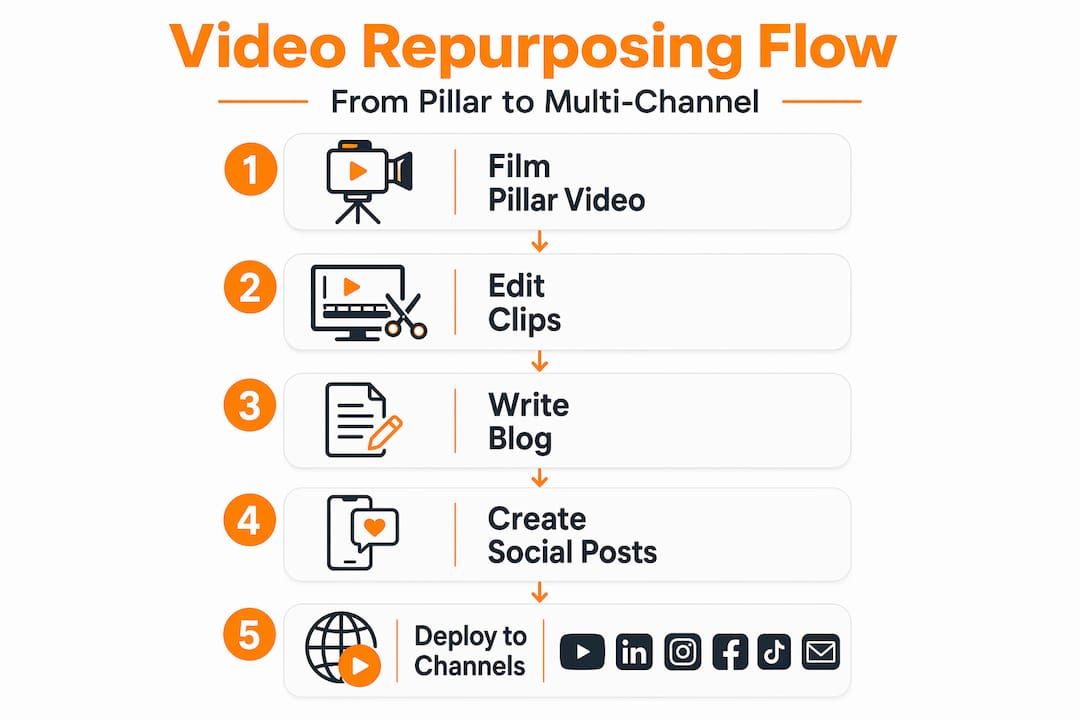
The repurposing component is what makes this model sustainable. Nearly 90% of marketing teams repurpose long-form pillar videos into multiple clips over months. A single 15-minute pillar video can produce short-form social clips, a written article, an email sequence, and pull quotes for LinkedIn. You are not creating more content. You are getting more out of what you already produce.
Why the benefits of video marketing are hard to ignore
The performance data behind a video first marketing approach is specific enough to inform budget decisions. Consider what happens when you add video to existing channels.
| Channel | Impact with Video |
|---|---|
| Landing pages | Up to 86% rise in conversions |
| Email campaigns | 200 to 300% higher click-through rate |
| Search results | Increased dwell time and lower bounce rate |
| Social feeds | Higher share rates and comment volume |
The landing page number is particularly significant. An 86% lift in conversions does not come from better copy or a redesigned button. It comes from giving visitors a faster, more engaging way to understand your offer.
"Video content on landing pages communicates value in seconds, reducing the cognitive load that causes visitors to leave before converting."
Email is another channel where the importance of video content becomes concrete. Adding a video thumbnail to an email, even if it links to a hosted video rather than playing inline, produces 200 to 300% higher CTR compared to static email campaigns. That is not a marginal improvement. It changes how you think about email design entirely.
The distribution advantage compounds over time. A well-structured video content strategy that consistently publishes Help content builds a library of searchable, evergreen assets. Each video continues driving traffic months or years after publication, unlike social posts that expire within days.

Mistakes that quietly kill your video strategy
Most video strategies do not fail because of poor production quality. They fail because of structural and behavioral errors that are easy to miss until the numbers tell you something is wrong.
Scripting for the brand instead of the viewer. This is the most common mistake at Cine. Brands produce videos about their history, their values, their process. Viewers are not searching for any of that. Videos answering common sales questions consistently outperform brand-centric content in search engagement. Start every video concept with a customer question, not a brand message.
Here are the other pitfalls worth watching for:
- Ignoring early engagement velocity. On Instagram, the first 30 to 60 minutes after posting determine how widely the algorithm distributes your content. Posting at the wrong time, when your audience is offline, means even great content gets suppressed before it has a chance.
- Treating data as a script. Channels that optimize purely for metrics often lose the creative voice that built their audience in the first place. Data should serve as a guardrail, not a replacement for editorial judgment.
- Producing in bursts without a publishing cadence. Ten videos in one month followed by silence hurts algorithm performance and audience trust equally. Consistency matters more than volume.
- Skipping the hook. The first two seconds of a video determine whether most viewers keep watching. Opening with a logo animation or a slow brand intro is one of the most reliable ways to lose your audience before you have said anything.
Pro Tip: Before scripting any video, write down the three questions your sales team hears most often. Those are your first three Help content topics.
How to build and implement your video first strategy
Building a video first strategy is a sequenced process. Skipping steps creates gaps that show up later as inconsistent performance.
-
Map your audience's questions. Pull from sales call recordings, customer support tickets, and search data. List every question your audience asks before, during, and after purchasing. These become your Help content topics. Listing customer FAQs as video topics produces better engagement and search performance than generic brand overviews.
-
Define your content pillars. Group your question list into three to five themes. Each theme becomes a content pillar. Your Hub and Hero content should connect to these same pillars so your channel has a coherent identity rather than a random assortment of topics.
-
Plan a sustainable publishing cadence. Regular, predictable publishing outperforms bursts followed by inactivity. Two videos per month, published consistently, will outgrow a channel that posts ten videos in January and nothing in February. Set a cadence you can hold for twelve months, not just four.
-
Optimize your hooks for the first two seconds. Starting with a direct question or specific claim outperforms branded intros every time. Your opening frame should create immediate curiosity or address a pain point directly.
-
Build your repurposing workflow. For every long-form pillar video you produce, plan how it will be broken down. Identify the three to five moments that work as standalone short clips. Pull a key quote for email. Write the blog post from the transcript. This workflow is what separates teams that scale from teams that burn out.
-
Schedule posts for peak engagement windows. Posting between 6 to 9 AM or 7 to 10 PM in your audience's timezone gives your content the best chance of generating the early engagement signals that trigger wider platform distribution.
Pro Tip: Batch-produce your Help content in blocks. Film four to six videos in a single production day, then schedule them across six to eight weeks. This keeps your calendar full without requiring weekly shoots.
Measuring what actually matters in your video strategy
Views are the least useful metric for evaluating a video first strategy. They tell you how many people started watching. They do not tell you whether the content worked.
| Metric | What It Actually Tells You |
|---|---|
| Audience retention rate | Whether your pacing and content structure are holding attention |
| Early engagement velocity | How the algorithm will distribute the video in the first hour |
| Comment sentiment | Whether viewers feel informed, skeptical, or confused |
| Click-through rate from video | Whether your call to action is landing |
| Cross-platform performance | Which topics resonate beyond a single channel |
Retention heatmaps reveal the exact points where viewers drop off, which tells you whether the problem is your hook, your pacing in the middle, or a weak close. If you see a consistent drop at the 45-second mark across multiple videos, that is a structural issue, not a one-off. Fix the pacing at that point and retest.
Comment analysis is underused. Reading comments for confusion, skepticism, or repeated questions gives you your next video topic and tells you whether the current video communicated clearly. Sentiment is qualitative data, but it is often more actionable than any chart.
The most important principle here is balance. Combining data literacy with creativity produces the most durable video channels. Use your metrics to identify what to fix. Use your creative judgment to decide how to fix it.
My take on what most video strategies get wrong
I have worked with enough marketing teams to see a clear pattern. The brands that struggle with video are almost always making the same mistake: they are producing content about themselves instead of content for their audience.
A company will spend weeks producing a beautifully shot brand story video that explains their mission and values. It gets 200 views. Then someone on the team films a quick, direct answer to a customer question on their phone and it gets 20,000. The lesson is not that production quality does not matter. It is that relevance matters more.
What I have found actually works is starting every content planning session with one question: what does our audience want to know right now? Not what do we want to say. What do they want to know. That shift changes everything about what you produce.
The other thing I have learned is that early engagement signals are not just a platform mechanic. They are a feedback signal. If a video gets strong early engagement, it means the topic and the hook resonated. If it gets weak engagement despite good production, the topic or framing missed. Most teams ignore this and keep producing. Smart teams use it to recalibrate.
Finally, do not let data paralyze your creative instincts. Metrics tell you what happened. They do not tell you what to make next. The teams that build durable video channels are the ones that use data to sharpen their instincts, not replace them.
— Shane
Ready to build a video first strategy that performs
If you are serious about implementing a video first content approach, production quality and strategic structure both matter. At Cine, we work with DTC brands and enterprise clients to build full-funnel video programs that connect strategy, production, and paid distribution into a single system.
Whether you need professional post-production editing to turn raw footage into polished pillar content, or you want to explore our full-funnel video marketing services that cover everything from scripting to paid media, Cine has the expertise to help you execute at a level that moves real business metrics. Reach out to discuss how a video first strategy can lower your customer acquisition costs and grow your ROI.
FAQ
What is a video first content strategy?
A video first content strategy means organizing your entire content plan around video as the primary format, then repurposing video assets into blogs, emails, and social content. It prioritizes video production at every stage of the content workflow.
How does the Hero, Hub, Help framework work?
The Hero, Hub, Help framework divides video content by purpose: Hero for broad awareness campaigns, Hub for regular engagement content, and Help for high-intent educational videos. Most strategies allocate 60 to 70% of output to Help content for SEO and passive traffic.
Why does early engagement matter so much for video?
Platforms like Instagram use engagement signals from the first 30 to 60 minutes after posting to decide how widely to distribute a video. Strong early engagement triggers broader reach, while weak early signals limit distribution regardless of video quality.
How do you repurpose a pillar video effectively?
A single long-form pillar video can be broken into short social clips, a written blog post from the transcript, email content, and pull quotes for LinkedIn. Nearly 90% of marketing teams use this repurposing approach to sustain content output without increasing production volume.
What metrics should I track beyond views?
Focus on audience retention rate, early engagement velocity, comment sentiment, and click-through rate from video. These metrics reveal whether your content is holding attention and driving action, not just accumulating passive impressions.
Recommended

Get total clarity on your video marketing and paid media with our FREE comprehensive data audit.
CINESALON NEWS